Flutter App Development Cost in 2026: Pricing & Key Factors
Flutter app development costs $15,000–$150,000+. See estimates by complexity, app type, team location, and hiring model, plus quote tips.

Bharat Purohit
Mobile App & Technology Consultant
In this Article
In this Article
- Cost to Develop a Flutter App
- 2How Much Does Flutter App Development Cost?
- 3Flutter App Development Cost by App Complexity
- 4Flutter App Development Cost by App Category
- 5Key Factors That Affect the Cost of Flutter App Development
- 6Flutter Development Cost by Team Location, Hiring Model, and Pricing Model
- 7Additional Costs to Consider Before Building a Flutter App
- 8How to Get an Accurate Flutter App Development Quote
- 9How to Reduce Flutter App Development Cost
- 10FAQs on Flutter App Development Cost
Let's Build the Right Solution, Not Just Software.

Summarize with AI
Short on time? Get the key points instantly with AI.
 ChatGPT
 Perplexity
Flutter App Development Cost in 2026: Pricing, Key Factors, and How to Budget
Quick Answer: Flutter app development costs $15,000–$150,000+ in 2026, depending on complexity, features, design, integrations, and team location. A basic app costs $15,000–$30,000 (2–3 months), a medium-complex app $30,000–$70,000 (3–6 months), and a complex app $70,000–$150,000+ (6–12+ months).
Flutter, Google's open-source UI toolkit, lets businesses build apps for Android and iOS (plus web and desktop) from a single codebase instead of developing separate native apps. But how much should you actually budget for development?
The cost to develop a Flutter app depends on more than the framework itself. Features, UI/UX design, backend development, third-party integrations, and the experience of your development team all affect the budget.
In this guide, we break down the cost of Flutter app development by complexity, app category, team location, and hiring model, then show you how to budget and get an accurate quote.
How Much Does Flutter App Development Cost?
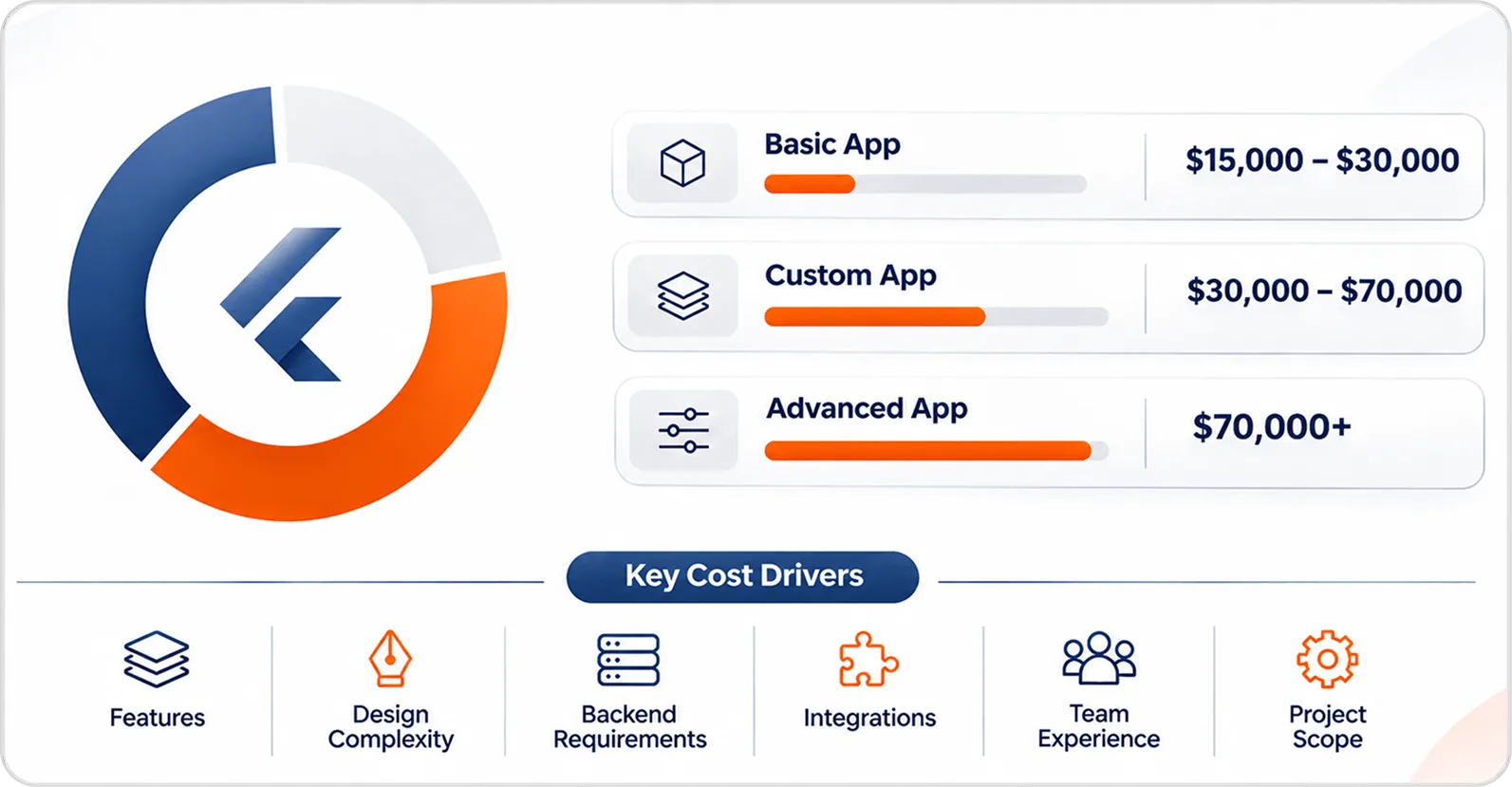
Flutter app development can cost anywhere from $15,000 to $150,000+, depending on the project's scope and requirements. A basic application with essential features may cost $15,000–$30,000. Apps with custom designs, payment gateways, and multiple API integrations typically cost $30,000–$70,000. Apps with real-time features, multiple user roles, or AI can exceed $70,000.
There is no fixed price for building a Flutter app. The final estimate depends on the features you need, the complexity of the design, backend requirements, third-party integrations, and the development team's experience.
To estimate your budget more accurately, it helps to look at app complexity first. Let's break down the costs for different types of Flutter applications.
Does Flutter Reduce App Development Cost Compared to Native Development?
In many cases, yes. Flutter helps developers build Android and iOS apps using a shared codebase. This reduces the need to develop and maintain two separate applications, which can lower development time and overall costs.
With native development, businesses typically need separate codebases using Swift or Kotlin. This can mean additional development resources, testing, and maintenance. Flutter helps reduce this duplication, especially for apps that share similar features and user experiences across both platforms.
However, Flutter does not automatically make every project cheaper. Apps that need advanced platform-specific features, complex animations, or deep device integrations may require additional work. The actual savings depend on your app's requirements and how much functionality can be shared across platforms.
Depending on your product requirements, hybrid app development may also be worth considering as an alternative approach. Explore our Hybrid App Development Services to understand when this approach makes sense.
The key is to compare the total development and maintenance effort, not just the initial development cost.
Flutter App Development Cost by App Complexity
App complexity is one of the biggest factors affecting Flutter app development costs. The number of features, design requirements, integrations, and user roles can change the amount of development work involved.
The table below provides a general cost estimate based on three levels of app complexity.
| App Complexity | Typical Features | Estimated Timeline | Development Cost |
|---|---|---|---|
| Basic App | User login, basic navigation, simple UI, limited features | 2–3 months | $15,000–$30,000 |
| Medium Complex App | Payment integration, push notifications, user profiles, custom dashboards, API integrations | 3–6 months | $30,000–$70,000 |
| Highly Complex App | Real-time features, advanced security, multiple user roles, AI features, complex backend systems | 6–12+ months | $70,000–$150,000+ |
Basic Flutter Apps ($15,000–$30,000)
Basic apps have a limited set of features and straightforward user flows. They usually include essential functions such as user registration, login, basic navigation, and simple content displays. A basic fitness tracker, calculator, or informational app can fall into this category.
Medium-Complex Flutter Apps ($30,000–$70,000)
These apps require more custom features and integrations. They may include payment gateways, user dashboards, push notifications, booking systems, and API connections. Examples include e-commerce applications, appointment booking platforms, and business dashboards.
Highly Complex Flutter Apps ($70,000–$150,000+)
Complex apps require advanced features, custom backend systems, and more detailed development work. They may support multiple user roles, real-time messaging, live tracking, AI-powered recommendations, or large-scale data processing. Social media platforms and multi-vendor marketplaces are common examples.
Note
These figures are indicative estimates, not fixed development quotes. Actual costs and timelines depend on the final requirements, technical choices, and development team. Category ranges in the next section overlap with these tiers because a simple app in any category costs less than a feature-rich one.

Planning Your Flutter App Development Budget?
Get expert guidance on Flutter app development costs, technical requirements, and the right development approach for your project. Let's turn your app idea into a practical development plan.
Flutter App Development Cost by App Category
Beyond complexity, the type of app you build affects cost. Different app categories require different features, integrations, and user experiences.
For example, an eCommerce app needs product listings, shopping carts, and payment gateways. A healthcare app may require appointment booking, patient records, and video consultations. These differences affect the time and resources needed for development.
Here is an estimated cost breakdown for different Flutter app categories:
| App Category | Common Features | Estimated Development Cost |
|---|---|---|
| E-commerce Apps | Product catalogs, search, shopping carts, payments, order tracking | $25,000–$80,000 |
| Business Apps | User accounts, dashboards, reports, task management, CRM integration | $15,000–$50,000 |
| Social Media Apps | User profiles, content feeds, messaging, comments, notifications | $40,000–$100,000+ |
| On-Demand Apps | Service booking, GPS tracking, payments, provider dashboards | $40,000–$120,000+ |
| Entertainment Apps | Media streaming, subscriptions, content discovery, offline access | $30,000–$100,000 |
| Healthcare Apps | Appointment booking, patient records, video consultations, health tracking | $30,000–$100,000+ |
| Education Apps | Online courses, live classes, quizzes, progress tracking, LMS integration | $25,000–$80,000 |
| Gaming Apps | Game levels, animations, multiplayer features, in-app purchases | $30,000–$150,000+ |
Note
These are indicative estimates for Flutter app development. The actual cost depends on the number of features, design requirements, integrations, and overall project complexity.
Key Factors That Affect the Cost of Flutter App Development
Now that we have covered the estimated costs by complexity and app category, let's look at what influences the final development budget.
Two apps in the same category can have very different costs. The difference often comes down to their features, design, technical requirements, and the resources needed to build them.
Here are the key factors to consider when estimating your Flutter app development cost.
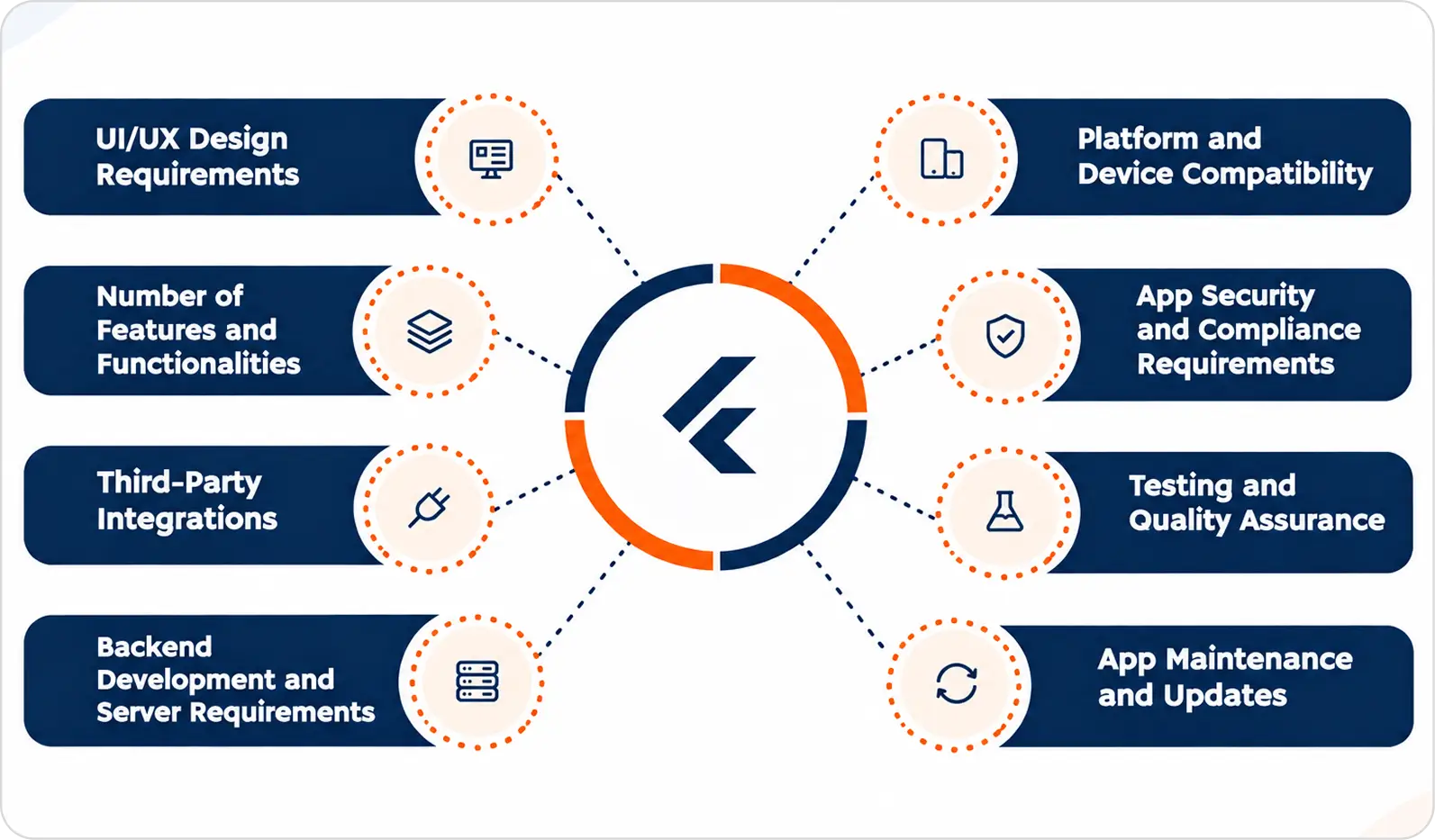
UI/UX Design Requirements
The design of your app affects both development time and overall cost. A simple interface with standard layouts requires less design work than an app with custom screens, animations, and interactive elements.
The design process also involves user research, wireframing, prototyping, and testing. Each step helps create an app that is easy to navigate and use.
If your app needs a unique look and feel, expect to spend more on UI/UX design. The number of screens and the level of customization will also affect the cost.
Number of Features and Functionalities
The features you include have a direct impact on the development budget. Basic features like user registration, login, and simple content screens are relatively straightforward to build.
However, adding features such as real-time messaging, payment processing, live tracking, and AI-powered recommendations requires more development effort.
For example, a basic fitness app may only need workout plans and activity tracking. Adding wearable device support, personalized coaching, and progress analytics will increase its development cost.
It helps to identify the features your users actually need before starting development. This keeps the initial scope manageable.
Third-Party Integrations
Many Flutter apps depend on external tools and services to provide additional functionality. These can include payment gateways, social media login, maps, analytics, cloud storage, and communication services.
Integrating these tools requires developers to connect different systems and make sure they work correctly with your app.
Some third-party services also charge based on usage or subscriptions. For example, an app with frequent map requests or video calls may have ongoing service costs.
The more integrations your app requires, the more time and budget you may need for development.
Backend Development and Server Requirements
The backend handles important operations such as user accounts, data storage, payments, notifications, and communication between the app and its servers.
A basic application with limited data requirements may need a simple backend setup. However, apps with multiple user roles, real-time updates, or large amounts of user data need more advanced systems.
Server costs also depend on storage, processing power, traffic, and security requirements. As your user base grows, you may need additional server resources to maintain app performance.
These requirements should be considered alongside the initial development budget.
Platform and Device Compatibility
Flutter allows developers to build applications for Android and iOS using a shared codebase. This can reduce the effort compared to developing separate native applications.
However, supporting multiple platforms still requires testing and platform-specific adjustments. Features such as camera access, location services, biometrics, and push notifications may work differently across devices.
If you also plan to support tablets, web browsers, or wearable devices, additional development and testing may be required.
Your target platforms and device requirements should be clear before development begins.
App Security and Compliance Requirements
Security becomes especially important when your app handles personal information, payments, or business data.
Features such as secure authentication, data encryption, access controls, and payment protection require careful planning and implementation.
Some industries also have specific compliance requirements. For example, US healthcare apps may need to comply with HIPAA, apps that process card payments must follow PCI DSS, and apps serving EU users must meet GDPR requirements.
The level of security and compliance required will affect the development approach, testing efforts, and overall cost.
Testing and Quality Assurance
Testing is an important part of building a reliable Flutter application. It helps identify bugs, check app performance, and ensure features work as expected.
The testing effort depends on the app's complexity and the number of platforms and devices it supports.
For example, a basic app may need functional and compatibility testing. An app with payments, real-time communication, or multiple user roles requires more detailed testing.
You should also account for performance, security, and usability testing where required. Skipping these checks may lead to issues after launch and higher repair costs later.
App Maintenance and Updates
The development budget should not end with the app launch. Every application needs regular maintenance to remain secure, stable, and compatible with newer devices and operating systems.
Maintenance may include:
Fixing bugs and performance issues.
Updating Flutter and third-party packages.
Improving existing features and user experience.
Adding new features based on user feedback.
Maintaining server security and performance.
As an initial planning guideline, some businesses reserve around 15–20% of their original development budget annually for maintenance and ongoing improvements. However, this is not a fixed industry rate.
Actual costs depend on application complexity, infrastructure usage, support expectations, security requirements, release frequency, and the amount of new development planned.
Flutter Development Cost by Team Location, Hiring Model, and Pricing Model
The factors discussed above influence the development effort and resources your app needs. However, the cost also depends on where your development team is based and how you choose to hire them.
Developer rates can vary significantly across regions. If you plan to Hire Flutter App Developers, your choice of location, experience level, and hiring model will influence the overall development budget.
Let's look at both factors to understand how they affect your Flutter app development budget.
Flutter Developer Cost by Location
The location of your Flutter development team has a direct impact on hourly rates. Developers in North America, Western Europe, and Australia generally charge more than those in Eastern Europe, South America, India, and other parts of Asia.
However, lower hourly rates don't always mean lower project costs. Developer experience, communication, technical skills, and project management also matter.
Here is a general comparison of Flutter developer rates across different regions:
| Development Region | Estimated Hourly Rate |
|---|---|
| North America | $50–$150 |
| Western Europe | $40–$120 |
| Australia | $40–$120 |
| Eastern Europe | $25–$80 |
| South America | $25–$70 |
| India and Asia | $20–$50 |
Note
These are indicative hourly rates. Actual rates depend on developer experience, company size, and project requirements.
Flutter App Development Cost by Hiring Model
Beyond location, your hiring model affects the overall budget. You can hire individual developers, build an internal team, or outsource the complete project to a development company.
Each option offers a different level of control, expertise, and cost flexibility.
| Hiring Model | How It Works | Cost Considerations |
|---|---|---|
| Freelancers | You hire individual developers for specific tasks or project requirements. | Lower initial costs, but you may need separate resources for design, testing, and backend development. |
| In-house Team | You hire full-time developers and other specialists to manage app development internally. | Higher ongoing expenses, including salaries, recruitment, infrastructure, and employee benefits. |
| Outsourcing | You partner with an app development company that manages the project through its development team. | Project-based or hourly pricing, depending on the scope, team size, and engagement model. |
For businesses without an existing technical team, outsourcing can be a practical option. You get access to developers, designers, testers, and project managers without hiring each specialist separately.
Flutter App Development Pricing Models
Development companies generally offer different pricing models based on project requirements and the level of flexibility you need.
The three common models include:

Fixed Price Model
Under this model, you agree on a fixed development cost before the project begins. It works well when your requirements, features, and project scope are clearly defined. You know the expected budget upfront, making financial planning easier. However, adding new features or changing requirements may involve additional charges.

Time and Material Model
With this model, you pay for the actual hours spent by the development team and the resources used. It works well for projects where requirements may change during development. You can add features, adjust priorities, and make improvements as the project progresses. However, the final cost may increase if the project takes longer than expected.

Dedicated Flutter App Developers Model
With this model, you hire dedicated Flutter developers who work exclusively on your project, providing consistent development support and flexibility as your requirements evolve. It works well for long-term projects, ongoing app development, maintenance, and feature enhancements. You can scale the team based on your needs while maintaining greater control over development priorities and timelines. This model typically follows a monthly billing structure, offering predictable costs without committing to a fixed project scope.
Additional Costs to Consider Before Building a Flutter App
Your development budget doesn't end with hiring developers or choosing a pricing model. Building and launching a Flutter app also involves expenses that may not be included in the initial development estimate.
These costs depend on your app's functionality, infrastructure, third-party services, and long-term requirements. Accounting for them early helps you avoid unexpected expenses during development and after launch.
Here are some additional costs to consider:
App Store and Play Store Fees
Publishing your Flutter app on Google Play and Apple's App Store involves developer account fees. Google Play charges a one-time registration fee of $25, while Apple charges $99 annually for its Developer Program.
Third-Party API and Service Costs
If your app uses payment gateways, maps, analytics, authentication, or other external services, you may need to pay subscription or usage-based fees. These costs can increase as your user base and API requests grow.
Cloud Hosting and Backend Infrastructure
Your app may require cloud servers, databases, file storage, and other backend resources to handle user activity and application data. Services like AWS, Google Cloud, and Firebase offer different pricing structures based on usage and storage requirements.
App Maintenance and Updates
After launch, your Flutter app will need regular maintenance to fix bugs, improve performance, update dependencies, and support new OS versions. Businesses should generally budget around 15–20% of the initial development cost annually for maintenance.
Marketing and User Acquisition
Launching an app doesn't guarantee downloads or active users. You may need to invest in app store optimization (ASO), paid advertising, content marketing, and other promotional activities to attract users and build visibility.
These expenses vary depending on your business model and app requirements. Discussing them during the planning stage helps you estimate the actual investment needed to build, launch, and maintain your Flutter application.
How to Get an Accurate Flutter App Development Quote
Knowing the average development costs is a good starting point, but it won't tell you exactly how much your app will cost.
To get a reliable estimate, you need to give the development company a clear picture of your app idea, features, and technical requirements. Here are some steps that can help you get a more accurate Flutter app development quote.
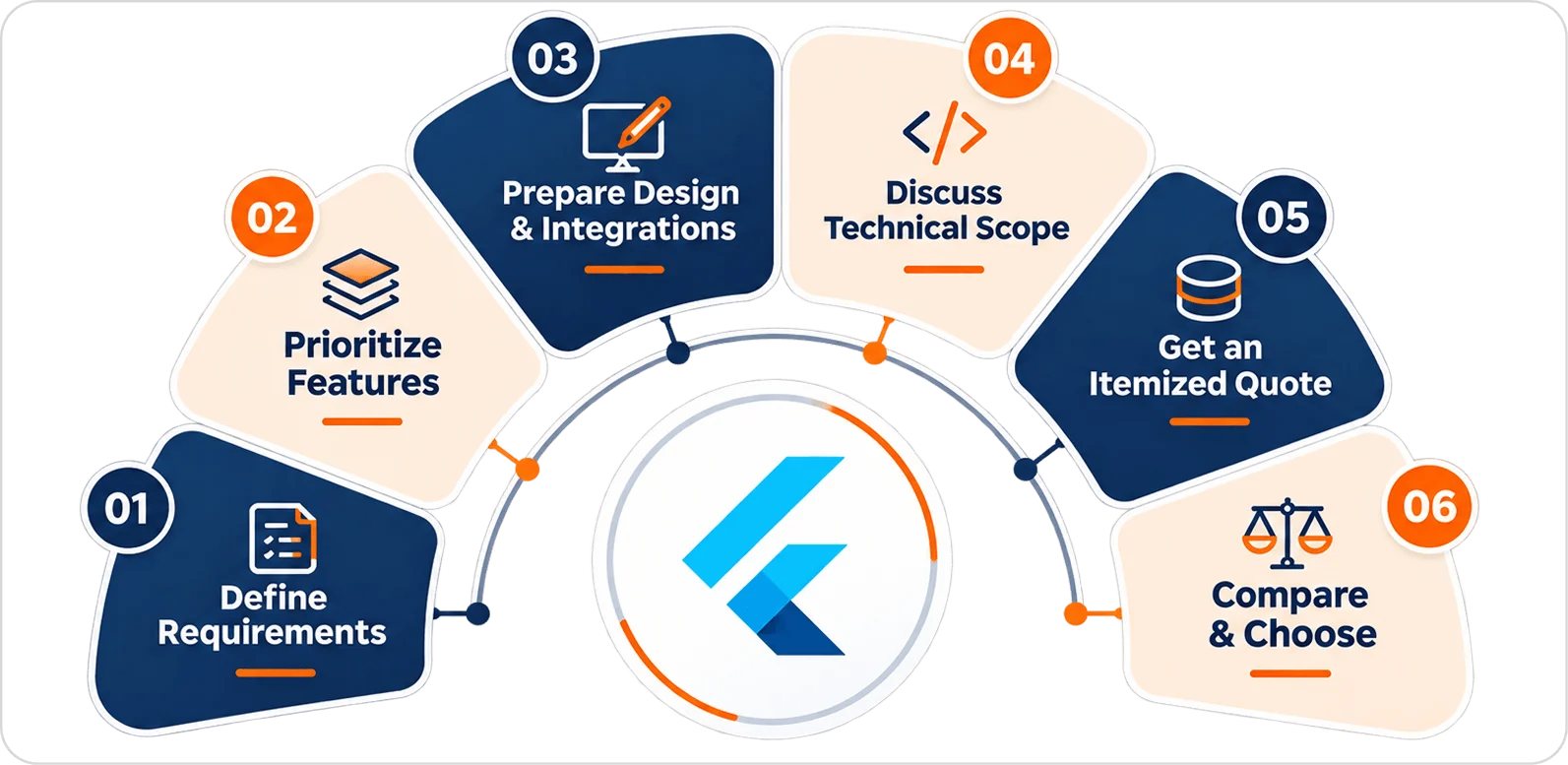
Define Your App Requirements
Start by outlining what you want your application to do. Identify its target users, main purpose, essential features, and the problems it should solve.
You don't need a complete technical document at this stage. However, having a clear feature list will help developers understand the project scope.
Also, mention whether you need Android, iOS, or both platforms. This helps the development team plan the right approach from the beginning.
Separate Essential Features From Future Requirements
Not every feature needs to be part of your first release. Divide your requirements into two groups:
Must-have features: Core functionality your app needs to serve its primary purpose.
Future features: Additional functionality that can be introduced after the initial launch.
This makes it easier for developers to estimate the initial scope without including features you may not need immediately.
Starting with an MVP can also help you test your app idea before investing in a larger product.
Prepare Your Design and Integration Requirements
Share any available design references, wireframes, or examples of applications you want to use as inspiration.
Also, list the third-party services your app may require, such as payment gateways, maps, analytics, CRM systems, or communication tools.
These details help developers estimate design work, integration efforts, and backend requirements more accurately.
Discuss the Technical Scope With Developers
Your app may have specific technical requirements that affect development time and cost. An experienced Flutter App Development Services provider can help assess these requirements and recommend an approach that fits your product.
Discuss important details such as:
Backend architecture and database requirements.
Expected number of users and traffic.
Data security and compliance needs.
Real-time features and API integrations.
Performance and scalability requirements.
An experienced development team can help identify technical challenges early and suggest suitable solutions.
Ask for an Itemized Cost Breakdown
Don't settle for a single development figure without understanding what's included.
Ask the development company to share a detailed estimate covering:
Requirement analysis and project planning.
UI/UX design.
Flutter frontend development.
Backend development and integrations.
Testing and quality assurance.
App deployment and launch.
Post-launch maintenance and support.
Also, ask about the estimated timeline, payment terms, and additional charges for changes outside the agreed scope.
Compare Quotes Beyond the Final Price
Getting estimates from multiple development companies can help you understand the market rates. However, choosing the cheapest quote isn't always the best decision.
Compare each proposal based on the team's Flutter experience, technical approach, project delivery process, communication, and post-launch support. Check whether the company has worked on similar applications and can handle your project's technical requirements.
A detailed quote should explain what you are paying for, how the team plans to build your app, and what you can expect at each stage.
The goal is to find a development partner who understands your requirements and can deliver the expected product within a realistic budget.
How to Reduce Flutter App Development Cost
You can reduce Flutter app development cost by launching an MVP first, releasing features in phases, reusing proven packages, using a backend-as-a-service (BaaS), defining requirements clearly, and choosing a pricing model that fits your scope. These steps cut waste without lowering quality.
Start With an MVP
A minimum viable product (MVP) includes only the features needed to solve your users' main problem. Instead of building every feature at once, you launch a focused version, collect real user feedback, and invest further only where it's justified.
This also protects your budget. If users don't respond to a feature, you find out before spending on it.
Release Features in Phases
Break your roadmap into releases. For example:
Phase 1: Login, core workflow, basic payments
Phase 2: Push notifications, user dashboards, analytics
Phase 3: Advanced features such as AI recommendations or multiple user roles
Phased releases spread spending across months, let you reprioritize based on user data, and reduce the risk of costly rework.
Reuse Proven Packages From pub.dev
Flutter's package ecosystem, pub.dev, offers ready-made packages for common needs such as authentication, maps, payments, state management, and charts. Using them saves developers time compared to building each feature from scratch.
Before adopting a package, have your developers check that it is actively maintained, well documented, and compatible with the current Flutter version. Also check its license. An abandoned package can create maintenance costs later.
Use Firebase or Another BaaS
A backend-as-a-service such as Firebase or Supabase provides ready-made authentication, databases, storage, and hosting. For many MVPs, this can remove the need for a fully custom backend, which shortens development time and reduces upfront cost.
Keep in mind that BaaS platforms usually charge based on usage, so costs grow with your user base. Apps with complex business logic or strict compliance needs may still need a custom backend.
Define Requirements Clearly Before Development Starts
Unclear requirements are a common cause of budget overruns. Changing features mid-project leads to rework, delays, and extra charges.
Before development begins:
Write a feature list, split into must-haves and future additions.
Share wireframes or reference apps.
List all third-party integrations.
Confirm your target platforms (Android, iOS, web, desktop).
A short discovery phase with your development partner is often worth the investment. It turns assumptions into a clear scope.
Choose the Right Pricing Model
Fixed price: Best when scope is clear and unlikely to change.
Time and material: Best when requirements may evolve.
Hybrid: Best for a defined core with flexible additions.
Choosing the wrong model can increase your cost. For instance, a fixed-price contract on a loosely defined project often leads to expensive change requests.
Prioritize Quality Over the Lowest Quote
The cheapest estimate often excludes testing, design, or post-launch support. Fixing a poorly built app can cost more than building it correctly the first time. Compare proposals on scope, process, and experience, not price alone.
Plan Your Flutter Investment With NebulaTech
Estimating Flutter app development costs is only one part of planning your project. The bigger decision is choosing the right features, architecture, and development approach before investing in the build.
We believe in clarity before code. The objective is not simply to build an app within a budget, but to make sure the investment supports the right product and technical decisions.
At NebulaTech, we follow a consulting-first approach to mobile app development. Before recommending a development approach, we work to understand:
The product vision and business objectives.
The users, workflows, and essential features.
Whether Flutter is the right technology choice.
The backend, integration, and architecture requirements.
Security, performance, and scalability expectations.
What should be included in the initial release versus future phases.
FAQs on Flutter App Development Cost
A Flutter app can take 2–3 months for a basic version, 3–6 months for a medium-complex app, and 6–12+ months for a complex application. The timeline depends on features, design, integrations, testing, and backend requirements.